Fully InsuredCommercial Liability Coverage
Emergency demolition · Toronto & the GTA
Emergency demolition.A controlled next step.
When damage interrupts the plan, define the removal—not just the urgency. Review non-structural interior demolition, protection and debris requirements with ROXA.
Call to confirm project fit and availability. A form does not dispatch a crew.
Immediate danger? Emergency services come first. ↓
Protect what remains.
WSIB CoveredWorkplace Compliance
Safety-trained crewsWAH, WHMIS and site documentation
Flexible SchedulingDays, Nights & Weekends
Toronto & the GTACommercial project support
Urgent does not mean unplanned
The right removal.
Not a wider problem.
Emergency demolition is urgent, controlled removal after damage or an unexpected condition.
For ROXA, the starting point is a review of non-structural interior scope: what needs to come out, what stays, and what must be resolved before work can begin. It is not a substitute for rescue, engineering, restoration or hazardous-material assessment.
After the source is controlled
Water-damaged interiors
Review damaged drywall, ceiling finishes, flooring and non-structural partitions for a defined removal scope. The restoration team establishes drying, contamination and salvage requirements; demolition follows those limits rather than stripping everything by default.
After the site is released for access
Fire-affected spaces
Review interior materials identified for removal after emergency responders and the responsible specialists have addressed access, stability and contamination. Fire investigation, smoke treatment and structural repair are separate responsibilities—not assumed demolition inclusions.
After work is stopped and assessed
Unexpected site conditions
An opened ceiling, damaged partition or concealed condition can interrupt a fit-out. Establish what must stop, what can remain and which approvals are needed before agreeing on a targeted non-structural removal package.
Every scenario is subject to assessment, authorisation and confirmed project fit. These are illustrative use cases, not completed ROXA incident case studies.
From uncertainty to a defined scope
One affected area.
A plan for everything around it.
Explore how removal limits, retained construction and access fit together. The same building stays in view at every stage—because the work outside the demolition scope matters too.
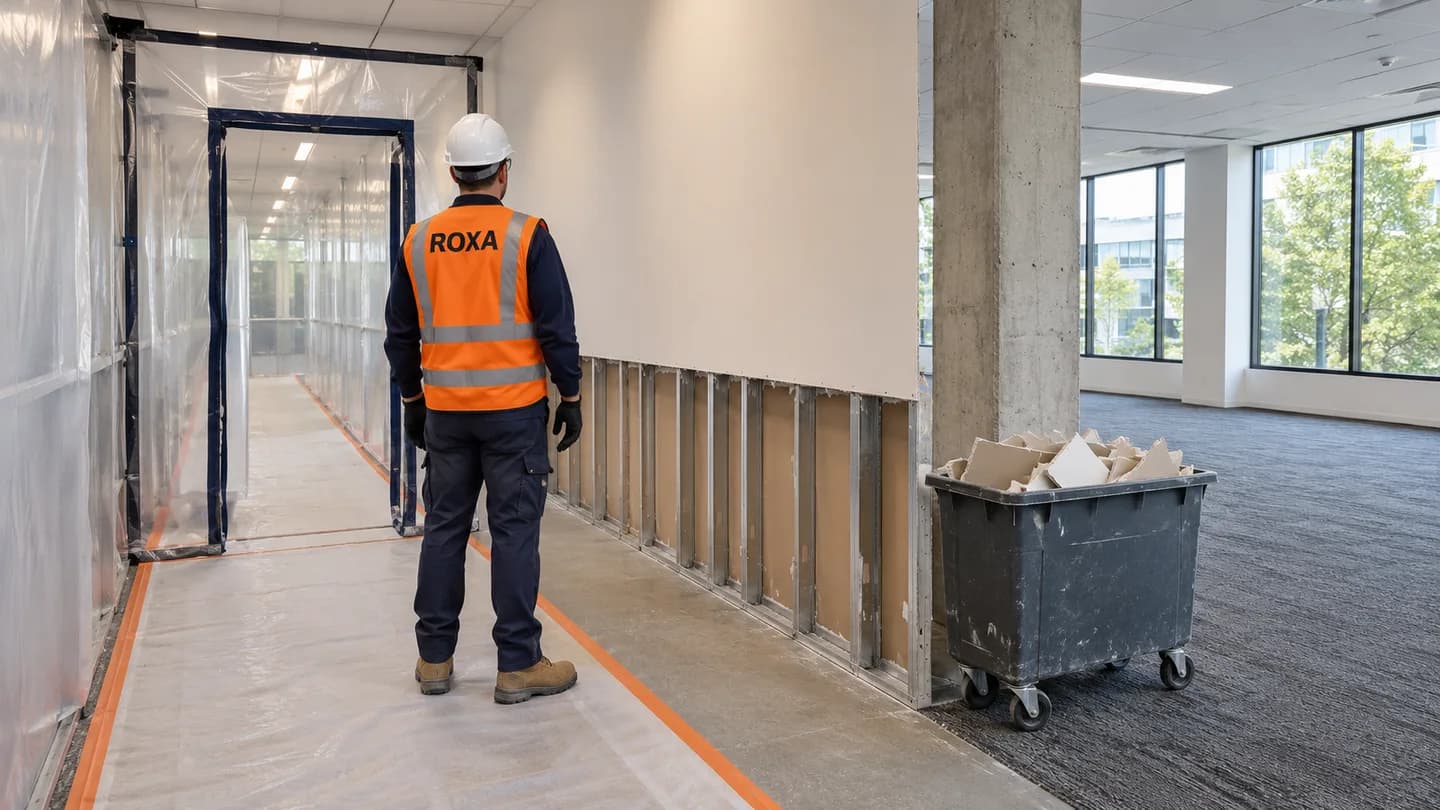
One unit. One defined intervention.Illustrative planning study
Removal limitsRetained constructionPlanned access
01 / 03
A defined work area and a list of prerequisites.
Confirm the limits before anyone cuts.
Identify the affected room, retained structure and restricted access. The responsible professionals address structural concerns, utilities and hazardous materials before a removal scope is released.
Scroll to explore ↓Select a stage
Concept only—not a site assessment, engineered sequence or occupancy approval.
Responsibility stays clear
A tight schedule does not erase the boundaries.
A removal package should name its exclusions as clearly as its inclusions. Share specialist reports and written directions before agreeing on work.
- Structure & stability
- Engineering, shoring, load-bearing removal and structural repair are not included in the standard interior scope described here.
- Utilities & live services
- Responsible qualified trades or utilities address affected services before related removal. Do not attempt isolation yourself.
- Hazardous materials
- Required assessment, testing and specialist abatement precede disturbance. Demolition barriers do not replace those procedures.
- Reoccupation & restoration
- Debris removal is not a clearance certificate. Drying, treatment, repair and return-to-use decisions remain with the responsible specialists and authorities.
Make the first conversation useful
The details that move a review forward.
You do not need a polished tender package. Send the information already available, identify what is unknown and tell us who is coordinating the site.
Only share photos you already have or can take from a safe, authorised location. Never cross a restricted boundary to complete this list.
- Site & contact
- Address, unit or floor, a site contact and the person authorised to approve work.
- What happened
- Incident type, when it occurred, affected rooms and any work already completed.
- Access status
- Who has released the space for access, current restrictions and any municipal orders.
- Scope evidence
- Existing photos taken from a safe location, drawings, reports and the proposed removal limits.
- Known hazards
- Utility status, structural concerns, designated-substances information and specialist instructions.
- Building logistics
- Occupied areas, loading, elevators, permitted work hours and the requested next step.
Cost & scheduling
Price the actual scope.
Confirm the actual constraints.
There is no responsible one-price answer for emergency demolition in Toronto. A meaningful quotation separates removal work from specialist prerequisites and states the access, disposal and handover assumptions.
Attendance and start dates are confirmed after review—not by the word “emergency.” If insurance is involved, ask your insurer about authorisation and evidence requirements; coverage is not guaranteed by a demolition quotation.
- Removal limits
- The materials, quantities and depth of removal—not simply the size of the building.
- Pre-work requirements
- Assessments, utility isolation, hazardous-material work and required authorisations.
- Access & containment
- Floor level, elevators, protected routes, adjacent occupants and work-area separation.
- Debris & handover
- Material streams, handling distance, disposal requirements and the condition needed by the next trade.
Practical answers
Before urgent work becomes a removal scope.
Clear answers about access, availability, permits, materials, cost and responsibility.
Read the official source notesWhat is emergency demolition?
Emergency demolition is urgent, controlled removal work following damage or an unexpected site condition. It may involve a limited interior scope or, in other projects, structural work directed by qualified professionals. ROXA’s page concerns review of non-structural interior removal, access, protection and debris requirements; it is not a rescue or structural-demolition service promise.
Who should I call if the building may be dangerous?
If someone may be in immediate danger, leave the affected area and call 911 from a safe location. Do not enter to take photos or try to remove unstable material. A demolition inquiry or website form is not an emergency-response channel. Follow emergency responders’ and the building authority’s instructions before arranging access.
Does ROXA offer 24/7 dispatch or a guaranteed arrival time?
No round-the-clock dispatch or fixed arrival time is promised on this page. Call to discuss the site and confirm availability. Any attendance depends on the location, access status, required approvals, hazards and crew availability. Sending a form does not book or dispatch a crew.
Can demolition begin before a permit is issued?
Do not assume that urgency waives permit requirements. The work proposed and the municipality determine the applicable approvals. Confirm the requirements with the local building department and share any order or written direction. A contractor’s review is not a permit, municipal authorisation or structural assessment.
Can you remove water-damaged drywall or ceilings?
These materials can be reviewed as part of a non-structural removal scope after access, utilities, material hazards and the removal limits are addressed. The appropriate restoration specialists determine drying, contamination and salvage requirements. Demolition does not by itself resolve a leak, prove materials are dry or make a room ready to reoccupy.
What about asbestos, mould or contaminated debris?
Tell the project team about suspected or identified hazardous materials before work is planned. Required assessment, testing and specialist treatment must be resolved before affected materials are disturbed. Asbestos abatement, mould remediation and hazardous-material clearance are not represented as ROXA services on this page. Ordinary demolition containment is not a substitute for those specialist procedures.
Is structural demolition or emergency shoring included?
No. Load-bearing walls, beams, columns, structural slabs, shoring and building stabilisation are outside the standard non-structural scope described here. Structural concerns require the appropriate qualified professionals, documentation and authorisation before related work. A drawing on this page cannot establish that a real building is stable.
How much does emergency demolition cost in Toronto?
There is no dependable flat price without a defined scope. Cost depends on the materials and quantities, access, containment, utility status, specialist prerequisites, debris handling and handover requirements. Send the available scope information for review. A preliminary conversation is not a binding quotation or a commitment to start.
Will my insurance cover the demolition?
Only your insurer can confirm coverage, authorisation, deductibles and claim conditions. Share relevant adjuster instructions before a scope is agreed, and ask what evidence should be retained. Demolition pricing and an insurer’s coverage decision are separate matters; ROXA does not guarantee that a claim will be paid.
Can the rest of the building remain occupied?
That decision cannot be made from a generic service page. It depends on the incident, assessments, utilities, air conditions, separation, exits and the directions of the responsible authorities and project team. An intact-looking room is not proof of safe occupancy. Any approved adjacent activity must fit the site-specific controls.
Which areas can I request a review for?
ROXA reviews project inquiries across Toronto and the Greater Toronto Area. Provide the exact address, unit and access conditions so project fit and availability can be confirmed. A service-area mention is not a guarantee of immediate attendance in every location.
Source notes
Useful guidance.
Not site-specific advice.
Official resources checked November 5, 2026. Requirements depend on the actual work and location. This page is general information, not engineering, legal, insurance or emergency advice.
- City of Toronto — emergency and non-emergency construction concerns
Who to contact when a construction or building condition may be dangerous.
- City of Toronto — when a building permit is required
Permit guidance; confirm the requirements for the actual work with the municipality.
- Ontario — asbestos in the workplace
Designated-substances information and responsibilities before work begins.
- CCOHS — demolition planning and hazards
General guidance on assessments, utilities, work zones and demolition planning.
A defined scope starts with the right information
Tell us what happened.Let’s review what comes next.
Share the address, access status, available photos and the removal requested. Project fit, prerequisites and availability are confirmed before any commitment.
Get a Project Review
Not a dispatch or emergency-response service.